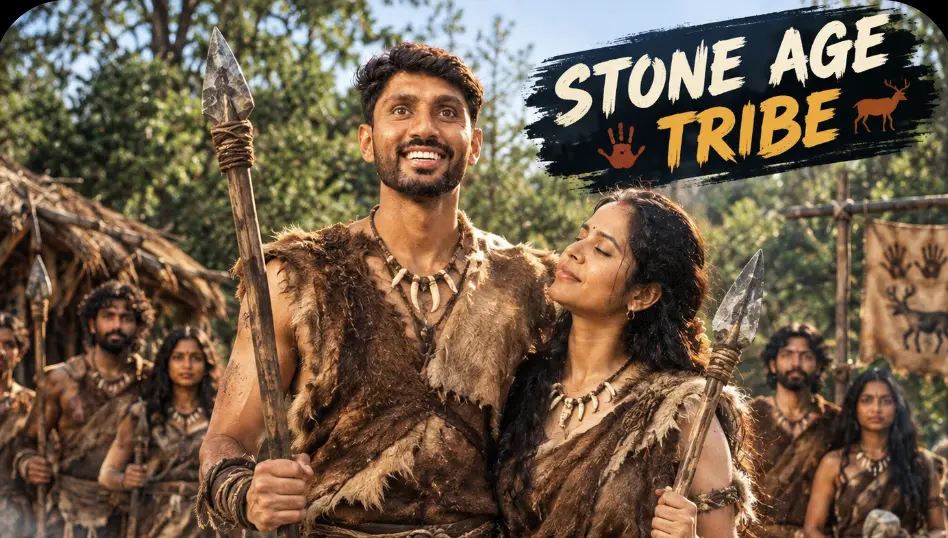
Just when everyone finished making their 1980s photos, the internet went further back. A lot further. The Pashan Yug trend has people turning themselves into Stone Age humans — leaves and animal hide for clothes, a wooden spear in hand, standing in a forest looking completely unbothered.
It’s the funniest trend of the year so far, and that’s exactly why it’s spreading. The 80s trend was nostalgic. This one is a joke, and jokes travel faster than nostalgia ever does.
But here’s what most people are getting wrong. They write the prompt like a serious cinematic brief — dramatic lighting, epic composition, National Geographic realism — and get back a genuinely impressive prehistoric documentary photograph that nobody laughs at and nobody shares. The comedy isn’t in the caveman. It’s in the contrast.
Pashan Yug AI Photo – Overview
| Detail | Information |
|---|---|
| Trend Name | Pashan Yug / Stone Age AI Photo Trend |
| Tools | ChatGPT or Gemini (Nano Banana) |
| Input | One clear photo of yourself (or a couple photo) |
| Style | Comedic prehistoric portrait |
| Output Ratio | 4:5 vertical or 9:16 for stories |
| Time | 2–3 minutes per image |
| Cost | Free tier works |
Why most Stone Age photos aren’t funny
Three mechanics decide whether people laugh or scroll past.
Your face has to stay completely modern. Not weathered, not aged, not made rugged and prehistoric. The joke is that you — the person your friends recognise, with your exact haircut and your exact expression — have somehow ended up in the Stone Age. The moment the AI ages your face or adds grime and battle scars, the joke disappears and you’re left with a stranger in a costume.
The expression should be deadpan, not dramatic. A caveman roaring at the sky is a movie poster. A caveman standing there looking mildly annoyed, like he’s waiting for a bus, is funny. Ask for a neutral or slightly unimpressed expression and the image improves instantly.
The setting should be ordinary, not epic. Cinematic sunsets and dramatic cliffs push it toward fantasy art. A plain forest, flat daylight, a slightly boring composition — that’s what makes it read as a photograph of a real situation, which is where the humour lives.
Get those three right and even a simple prompt works. Get them wrong and no amount of prompt length will save it.
The Classic Solo Pashan Yug Portrait
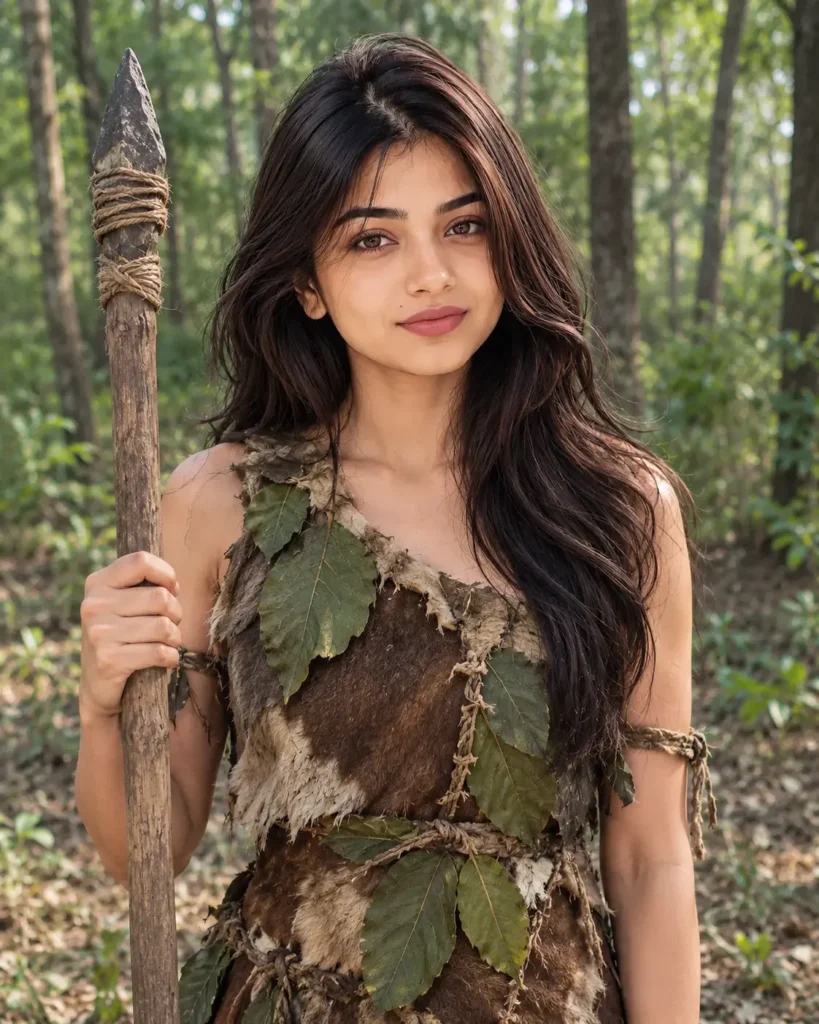
The base prompt. Start here.
Edit the uploaded photo into a Stone Age scene featuring the same person.
IDENTITY: Keep the face exactly as in the uploaded image — same facial
structure, same hairstyle, same skin tone, same modern grooming. Do not
age the face, do not add dirt, scars or weathering, do not make the face
look rugged or primitive. The face must stay instantly recognisable.
WARDROBE: Simple prehistoric clothing made of animal hide and large
leaves, fully covering the body, roughly stitched.
POSE: Standing upright holding a wooden spear, facing the camera with a
completely neutral, slightly unimpressed expression. Not heroic, not
dramatic.
SET: An ordinary forest clearing with tall trees and undergrowth. Plain
flat daylight, no dramatic sunset, no fog, no epic landscape.
CAMERA: 50mm, eye level, straightforward composition, nothing stylised.
FINISH: Realistic photograph, natural colours, real skin texture with
visible pores, fine grain. Not a movie poster, not fantasy art.
OUTPUT: 4:5 vertical, high resolution.
The Couple Version
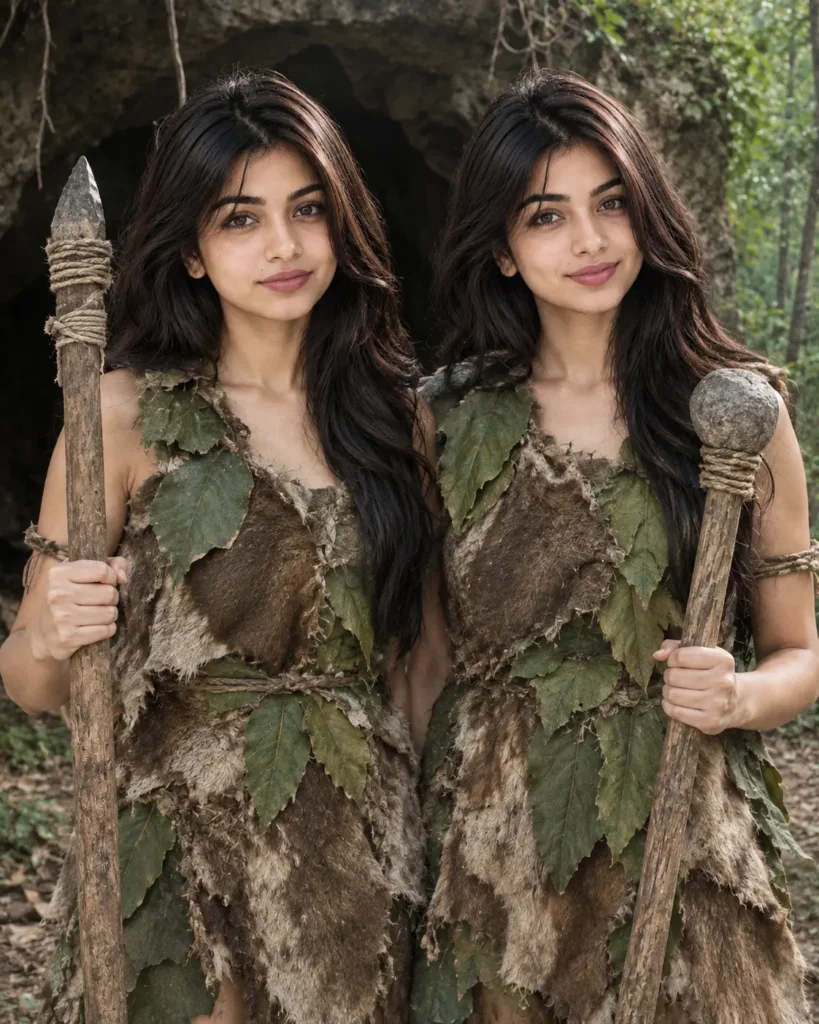
The most-shared variant of this trend, and the one that gets tagged in comments.
Combine the two uploaded reference photos into one Stone Age scene with
both people together.
IDENTITY: Person A must match reference image 1 exactly and person B
must match reference image 2 exactly. Do not blend or average the two
faces. Keep both faces modern, clean and instantly recognisable — no
ageing, no dirt, no weathering on either face.
WARDROBE: Both wearing simple animal hide and leaf clothing, fully
covering, roughly made.
POSE: Standing side by side, both holding wooden tools, both looking
straight at the camera with flat neutral expressions, as though posing
for an ordinary family photograph.
SET: Outside a cave entrance in a plain forest. Flat overcast daylight.
CAMERA: 50mm, eye level, centred composition like a posed snapshot.
FINISH: Realistic photograph, natural colour, real skin texture,
fine grain. No cinematic grading.
OUTPUT: 4:5 vertical, high resolution.
Note on couples: identity drift doubles with two faces. The “do not blend or average” line is doing real work — don’t remove it.
The Tribe Group Photo
Works with a group photo of friends, and it’s the version that performs best because everyone in it shares the post.
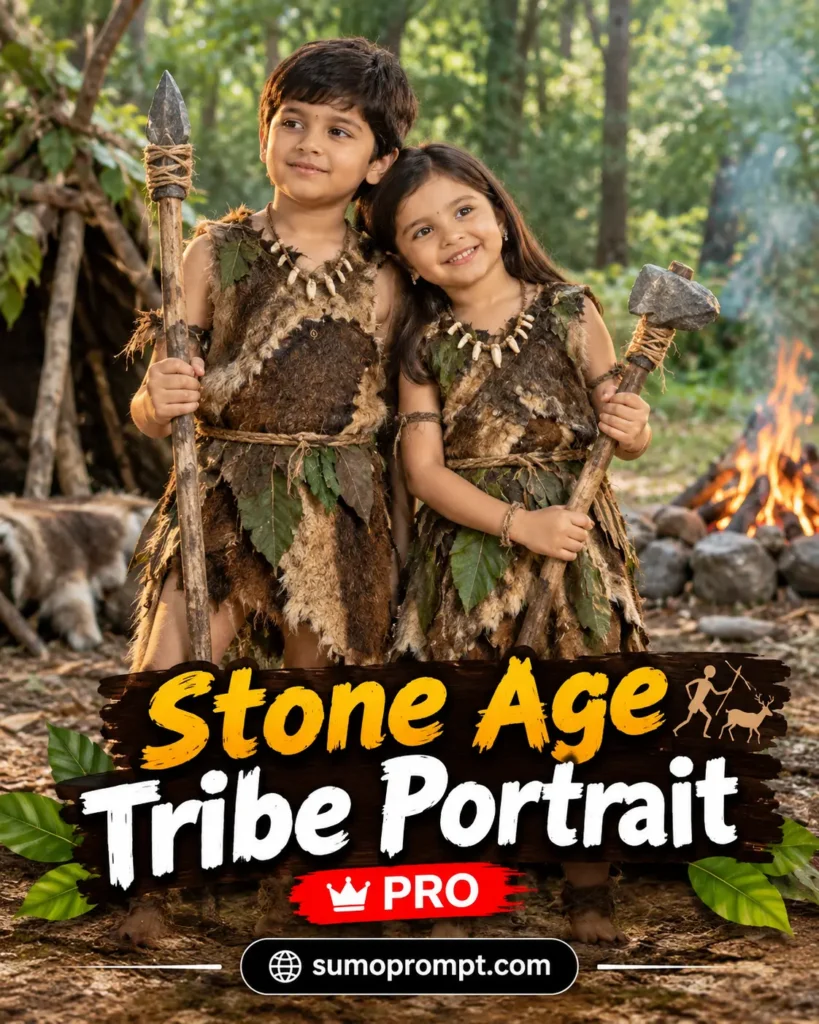
Edit the uploaded group photo into a Stone Age tribe portrait.
IDENTITY: Every person's face must match the uploaded photo exactly —
same features, same hairstyles, same skin tones, all clearly
recognisable. Do not age anyone, do not add dirt or weathering, do not
merge any two faces together.
WARDROBE: All wearing simple hide and leaf clothing, fully covering,
each slightly different.
POSE: Standing in a loose row holding wooden spears and stone tools,
everyone facing the camera with plain neutral expressions, like a badly
organised group photograph.
SET: Forest clearing beside a small fire. Flat daylight.
CAMERA: Wide shot, eye level, everyone fully visible.
FINISH: Realistic photograph, natural colours, real skin texture,
fine grain.
OUTPUT: 4:5 vertical, high resolution.
The Cave Painting Version
A different angle on the same trend — you as a figure painted on a cave wall. Less common, which right now is an advantage.
Create an image of an ancient cave wall painting depicting the person
from the uploaded photo.
LIKENESS: The painted figure should be simple and primitive in style,
but keep one or two clearly recognisable details from the reference —
[hairstyle, glasses, beard shape] — so the person is identifiable.
STYLE: Ochre, charcoal and rust-red pigment on rough grey stone, simple
outlines, the visual style of genuine prehistoric cave art.
SCENE: The figure holding a spear beside simple animal shapes and hand
prints.
SURFACE: Uneven rock texture with cracks, natural stone colour
variation, faint dust.
LIGHT: Warm flickering firelight from the lower left, deep shadow in the
recesses of the rock.
FINISH: Photograph of a real cave wall, not a digital illustration.
OUTPUT: 4:5 vertical, high resolution.
The one line that makes any of these funnier
Add a single modern object to the scene. That’s it — that’s the whole upgrade, and it’s what separates the versions getting thousands of shares from the ones getting fifty likes.
Add any of these lines to the end of a prompt above:
He is holding a modern smartphone in his other hand, looking at the screen.
A plastic chair sits incongruously in the background of the forest clearing.
He is wearing modern sneakers with the hide clothing.
A steel tiffin box rests on the rock beside him.
The absurdity of one out-of-place object does more comedic work than any amount of prompt detail. Keep it to one object though — two or three turns it into a random mess and the joke stops reading.
Keeping your face yours
The most common complaint with this trend is that the result looks like a stranger. Almost always one of three causes.
The prompt asked for weathering. Words like “rugged”, “primitive features”, “weathered” and “hardened” tell the model to restructure the face. Every prompt above explicitly refuses them.
The source photo is filtered. A beauty-filtered selfie hands the model pre-smoothed features to work from, and it fills the gaps with invented ones. Use an unfiltered, front-facing, well-lit photo.
Too many changes at once. Wardrobe, setting, lighting and expression is already a lot. Adding pose changes and camera angles on top of it is where likeness breaks. Change one thing per regeneration.
Posting it
The caption format driving this trend is the joke about time travel — people framing it as a follow-up to the 80s trend, going back further and further. That framing is doing a lot of the work, so lean into it rather than posting the image bare.
A few practical notes. Post it as a single image, not a carousel of eight variations — the joke is a one-liner and repetition kills it. Tag whoever is in it with you, because the tagged person’s story reshare is where most of the reach comes from on this kind of content. And post it this week, because comedy trends burn out faster than aesthetic ones. The 80s trend ran for a month. This one won’t.
Frequently Asked Questions
Does this work on the free version of ChatGPT? Yes. The free tier limits daily generations but the prompts work identically.
Which tool is better for this trend? Gemini holds facial likeness slightly better, which matters more here than usual because the whole joke depends on people recognising you.
Why does my face look completely different? Your prompt probably asked for a rugged or weathered look, or your source photo was filtered. Use the identity block above without editing it.
Can I do this with a couple photo? Yes — use the couple prompt above with two separate reference images. Expect a few more regenerations than the solo version.
How many times should I regenerate? Two or three. Comedy images are more forgiving than portraits, so the first usable result is often good enough.
Can I use it for a group of friends? Yes, though more faces means more drift. Four or five people is about the practical limit before likeness starts breaking down.
Conclusion
The Pashan Yug AI photo editing prompt works on one principle: keep the face modern, keep the expression flat, keep the scene ordinary, and let the situation be the joke. Everything else is decoration.
Start with the solo prompt, add one out-of-place modern object, and post it before the trend cools. Comedy formats move fast, and this one arrived about a week ago.