Most romantic prompt lists give you the same thing on repeat — one girl, some flowers, a film grain filter. Meanwhile the thing people actually search for is different: building a couple portrait out of two separate photos. Below are six prompts, solo and couple, each with a note on the kind of source photo it actually works on.
Set these three things before you paste anything
Thirty seconds of setup, and it decides most of your result.
- Source photo. Face clearly visible, facing the camera, no beauty filter applied. A pre-filtered selfie hands the model already-distorted features, so the output looks like someone else — and that’s not the prompt’s fault.
- Ratio. Use 4:5 vertical (1080×1350 px) for both Instagram feed and Pinterest. Generate 9:16 separately for stories instead of cropping down.
- Tool. Face-preserving editors (the Gemini class of models) hold a likeness better for portraits and couples. Midjourney gives richer texture but drifts further from the reference face.
1. Couple Portrait From Two Separate Photos
This is the highest-demand request in the entire romantic category. You don’t have a single decent photo together — long distance, or it just never happened. Upload two separate selfies and run this.
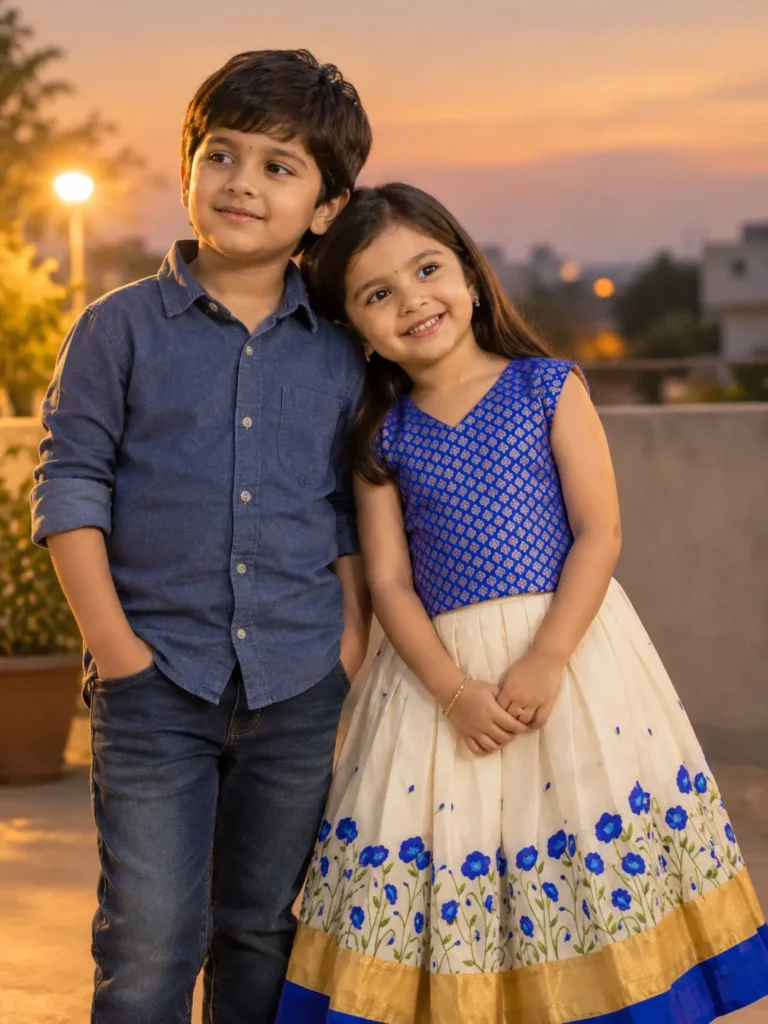
Combine the two uploaded reference photos into one single realistic photograph of the same two people standing together.

FACE LOCK: Person A must match reference image 1 exactly — same face shape, same eyes, same skin tone, same facial proportions and distinctive facial features. Person B must match reference image 2 exactly. Do not blend, average, merge or exchange the two faces. Do not slim, reshape or beautify either face. Do not change either person's skin tone to match the other.

POSE: Standing naturally close together, [her head resting lightly on his shoulder], both looking slightly away from the camera. Their expressions should feel relaxed, genuine and candid rather than deliberately posed.

BODY & SCALE: Keep a realistic height difference between both people. Preserve natural body proportions, realistic shoulder width, posture and believable physical positioning. Avoid distorted anatomy or unnatural overlapping.

SET: [Terrace at dusk], with a warm street-light glow softly visible behind them and a subtle atmospheric haze in the distance. Keep the environment realistic and understated so the two people remain the primary focus.

LIGHTING: Use a single warm light source coming from the left. Maintain consistent light direction across both faces and bodies, with soft realistic shadows between them and natural falloff into the background.

CAMERA: 50mm portrait lens, f/2.0, eye-level camera position, natural perspective and realistic depth of field. Both people should remain naturally proportioned without wide-angle distortion.

SKIN & DETAIL: Preserve authentic skin texture, visible pores, natural facial details and individual hair strands. Avoid artificial skin smoothing, plastic-looking skin or excessive retouching.

COLOR & FINISH: Warm neutral color grade with realistic skin tones, subtle highlight warmth, natural contrast and delicate film grain. Maintain believable exposure and realistic photographic detail.

PHOTOGRAPHIC STYLE: High-quality realistic lifestyle photography that still feels like a genuine photograph rather than a studio composite. Natural imperfections, authentic expressions and believable environmental lighting.

IMPORTANT: No CGI look, no plastic skin, no face distortion, no facial blending, no face swapping between subjects, no beautification, no artificial symmetry, no exaggerated HDR, no excessive sharpening, no unrealistic anatomy, no watermark, no logo and no readable text anywhere in the image.
Works best on: two photos shot in similar lighting. Mixing a bright daylight selfie with a dim indoor one gives you a pasted-on face every time.
2. Vintage 35mm Rose Portrait — the safest one here
Muted colour, heavy grain, soft window light. Lowest failure rate of any Romantic AI Photo Prompt on this page, which makes it the right one to start with.
Restyle the uploaded photo as a vintage 35mm film romantic portrait.
FACE LOCK: Preserve the exact face from the reference — same features,
same natural skin texture. No smoothing, no reshaping.
POSE: Head tilted back slightly, eyes closed, holding a bunch of
[dusty pink roses] close to the chest, a few strands of hair falling
across the face.
PALETTE: Muted and desaturated — faded rose, warm cream, soft brown.
Nothing bright, nothing neon.
LIGHT: Late afternoon sun coming through a window from the side,
one soft highlight on the cheekbone, everything else in gentle shadow.
CAMERA: 35mm film camera, f/2.8, slight vignette at the corners.
FINISH: Heavy visible film grain, slightly lifted blacks, small halation
around the highlights. Looks like a scanned film negative, not a digital
photo.
Works best on: any front-facing selfie. The grain and shadow cover up whatever the original photo was lacking.
3. Monsoon Romance
Strong seasonal search from July through September, and barely any competition for it — almost every romantic prompt page sticks to flowers and pastels.
Turn the uploaded photo into a candid monsoon romance portrait.
FACE LOCK: Keep the exact facial features, hairline and skin tone from
the reference image. Keep any moles or freckles visible.
SCENE: Standing under light rain on an old street, wet hair sticking
slightly to the forehead, water droplets on the skin and eyelashes.
Holding a [black umbrella] tilted back, laughing naturally.
BACKGROUND: Rain-soaked road reflecting [yellow shop lights], blurred
traffic far behind, wet leaves on a parked scooter.
LIGHT: Overcast diffused daylight with warm artificial light spilling
from the shops on the right.
CAMERA: 85mm, f/1.8, shot slightly from the side, rain streaks visible
in the background blur.
FINISH: Cool blue-grey grade with warm highlights, realistic wet skin,
natural grain. No glossy filter look.
Works best on: photos with hair down. The wet-hair effect looks fake over a tied-back hairstyle.
4. Retro 90s Film Still — couple
A nostalgia format, and it out-performs on shares because people compare the results to their parents’ old photographs.
Create a single retro 1990s film still using both uploaded reference
photos as the two people.
FACE LOCK: Person A from reference 1, person B from reference 2. Keep
both faces exactly as in the references. Do not merge the faces.
STYLING: Period-correct 90s clothing — [her in a chiffon saree with a
simple gold chain], [him in a plain shirt with rolled sleeves]. Era hair
and makeup, no modern accessories, no phones anywhere in frame.
SCENE: [Hill station road lined with pine trees], soft mist behind them,
both mid-conversation, neither looking at the camera.
LIGHT: Flat overcast daylight, gentle fill, no harsh shadows.
CAMERA: Anamorphic 40mm, f/2.8, wide framing with generous headroom,
slight lens softness at the edges.
FINISH: Faded print colour, slightly green shadows, heavy grain, fine
scratches like an old reel. Should read as a frame from a 90s film.
The mistakes that ruin couple prompts
A solo portrait means holding one face steady. A couple means two, and this is where most attempts fall apart.
- The faces merge. Ask for “a couple photo of these two” and the model averages both references into one generic face applied twice. That’s exactly why the prompts above spell out do not blend or average the two faces — don’t delete that line.
- The lighting doesn’t match. Two references shot under different light produce one person who looks pasted in. Matching light direction on both faces is doing real work in the prompt.
- The heights come out wrong. Left alone, the model makes both people the same size. State the actual difference in the brackets.
- You changed everything at once. Get the two of them into one believable frame first. Change outfit and background in a second pass. Ask for all of it together and the likeness is the first thing to go.
- You kept the first output. Generate at least three times. The usable one is normally the second or third.
Before you post
- Keep the grain. Every prompt ends with a grain instruction. Clean it up in post and the image immediately reads as AI.
- One at a time. A feed full of obvious AI portraits kills reach faster than any single image builds it.
- Don’t beg for prompt requests. “Comment for the prompt” captions get scrolled past now. A short line about the imagined moment behind the photo is what actually pulls comments.
FAQs: Romantic AI Photo Prompts
Do these work on free tools? Yes. Everything here is plain English with no tool-specific syntax. Free tiers just cap your resolution and your daily generation count.
Does the two-photo couple prompt work everywhere? No. Multi-reference input isn’t universal. Use a tool that accepts more than one uploaded image, otherwise only the first face comes through.
How do I keep the face exactly the same? Write the face lock as refusals — no slimming, no smoothing, no reshaping — and paste those lines again on every regeneration. Naming one or two unique features, like a mole or a specific hairline, sharpens it further.
Which one should I try first? The vintage 35mm rose portrait. It fails the least and works on an ordinary phone selfie.
Also Read: